Synapse
Also known as: synaptic junction, chemical synapse
In one sentenceA synapse is the junction where one neuron passes a signal to the next. Most are chemical synapses that relay the signal by releasing neurotransmitters.
Structure
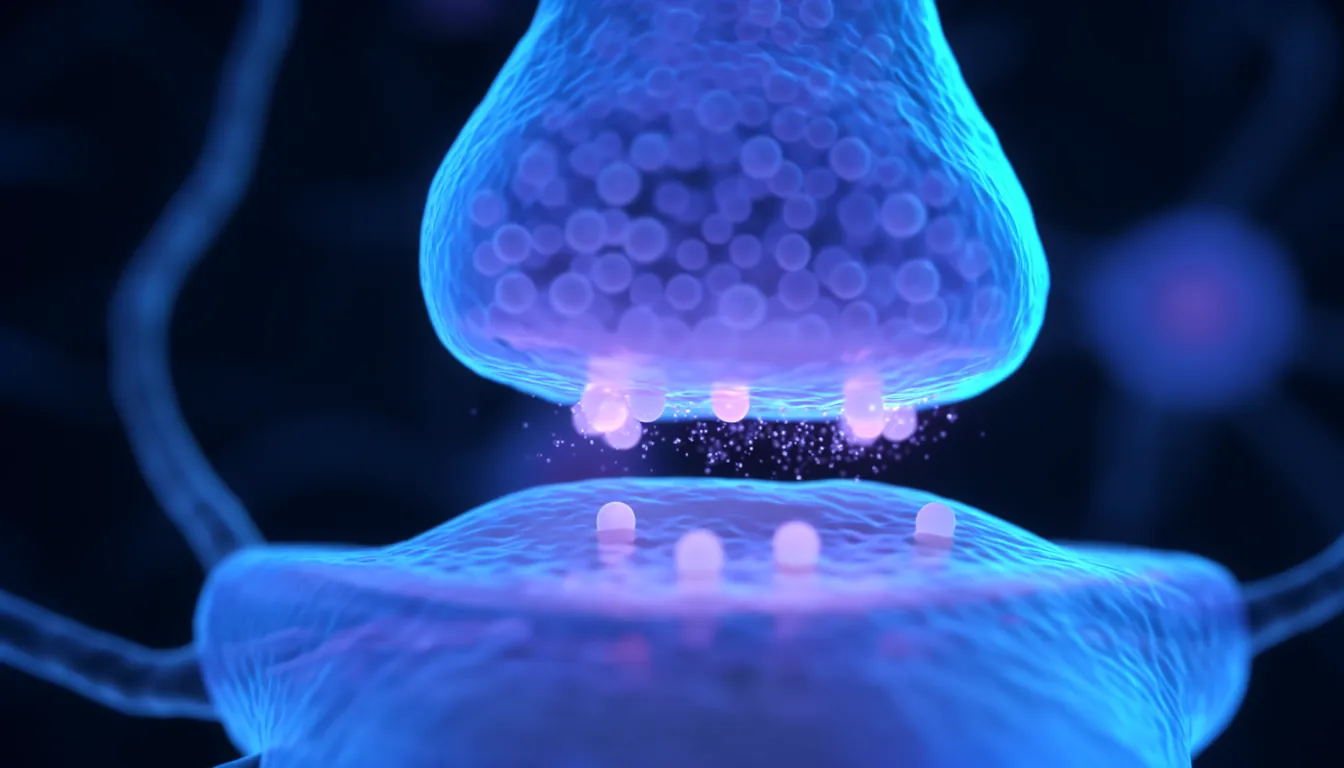
A synapse has a sending side (the axon terminal of the presynaptic neuron), a receiving side (a dendrite or cell body of the postsynaptic neuron) and a gap a few tens of nanometers wide between them. A single neuron makes and receives thousands of synapses, wiring itself into neural circuits.
How a signal crosses
- An electrical signal (an action potential) reaches the axon terminal, and calcium ions flow in.
- Calcium triggers small sacs called vesicles to fuse with the membrane and release neurotransmitter into the gap.
- The neurotransmitter binds receptors on the receiving cell, opening ion channels or switching on signaling inside the cell.
- The receiving cell becomes more likely to fire (excitatory) or less likely to fire (inhibitory).
Chemical and electrical synapses
Most synapses in the brain are chemical synapses like the one above. Some are electrical synapses, where channels called gap junctions let ions flow directly between two cells, passing the signal even faster.
Common neurotransmitters
- Glutamate: the brain’s most common excitatory neurotransmitter
- GABA: the most common inhibitory neurotransmitter
- Dopamine: involved in movement and reward learning
- Serotonin, acetylcholine, norepinephrine and others
Synapses change
Synaptic strength is not fixed. In 1973 Bliss and Lømo reported that brief, strong stimulation of a pathway in the rabbit hippocampus left synaptic responses enlarged for a long time afterward, a phenomenon called long-term potentiation. This capacity of synapses to change with experience is called neuroplasticity.
Related entries
- Neural circuit — A neural circuit is a group of neurons connected by synapses that work together to carry out a specific function such as sensory processing, movement or memory.
- Neuroplasticity — Neuroplasticity is the brain's capacity to change synapses and connections with experience, the cellular basis of learning and memory.
- Dopamine — Dopamine is a neurotransmitter for movement, motivation and reward learning. Often called the pleasure chemical, it mainly signals prediction errors.
References
- Principles of Neural Science, 6th ed.. Kandel ER, Koester JD, Mack SH, Siegelbaum SA (eds). McGraw Hill (2021)
- Long-lasting potentiation of synaptic transmission in the dentate area of the anaesthetized rabbit following stimulation of the perforant path. Bliss TVP, Lømo T. Journal of Physiology 232, 331–356 (1973)