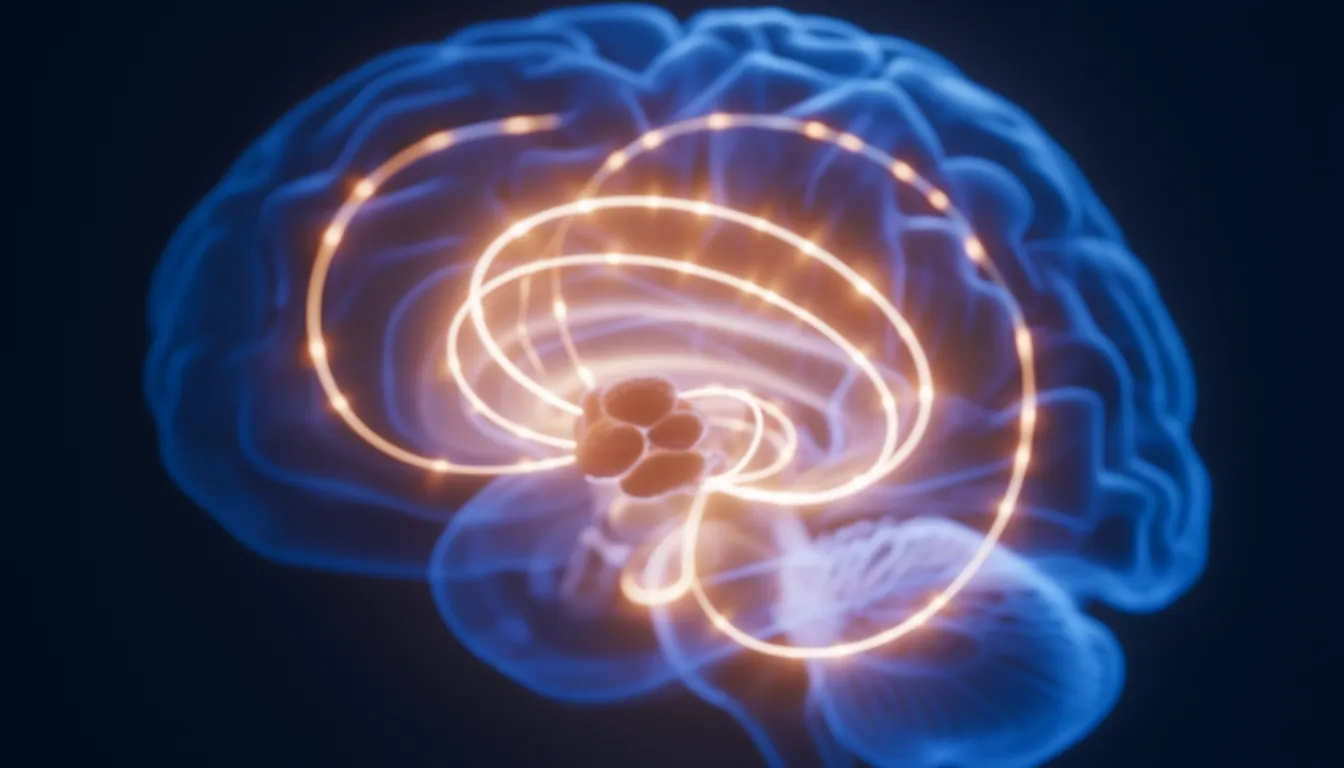
Dopamine
Also known as: dopamine pathways
In one sentenceDopamine is a neurotransmitter for movement, motivation and reward learning. Often called the pleasure chemical, it mainly signals prediction errors.
Where it comes from
Neurons that release dopamine are clustered mainly in two midbrain areas, the substantia nigra and the ventral tegmental area. They send signals to wide regions such as the striatum of the basal ganglia and the prefrontal cortex.
Movement
The pathway from the substantia nigra to the striatum is important for starting and controlling movement. Parkinson’s disease research has long identified the loss of dopamine neurons in this pathway as a core feature.
A signal that the prediction was wrong
In 1997 Wolfram Schultz and colleagues summarized monkey experiments suggesting that dopamine neurons respond less to reward itself than to the difference between what was expected and what happened.
- An unexpected reward makes dopamine neurons fire strongly.
- Once a cue that predicts reward is learned, the neurons respond to the cue rather than the reward.
- If an expected reward fails to arrive, their activity dips.
This reward prediction error signal is read as a teaching signal for learning which actions lead to good outcomes, and it connects to reinforcement learning theory in artificial intelligence.
The pleasure chemical myth
Kent Berridge and Terry Robinson argued that dopamine has more to do with wanting, the motivation to pursue something, than with liking it. Calling dopamine simply a happiness chemical does not match the research.
Discovery
In the 1950s Arvid Carlsson showed that dopamine is a neurotransmitter in its own right rather than just a precursor of other molecules, work recognized with the 2000 Nobel Prize in Physiology or Medicine.
Related entries
- Basal ganglia — The basal ganglia are deep brain nuclei that loop with the cortex and thalamus to start and select movements and to learn habits.
- Synapse — A synapse is the junction where one neuron passes a signal to the next. Most are chemical synapses that relay the signal by releasing neurotransmitters.
- Prefrontal cortex — The prefrontal cortex, just behind the forehead, runs executive functions such as planning, impulse control and working memory, and matures last.
References
- A neural substrate of prediction and reward. Schultz W, Dayan P, Montague PR. Science 275, 1593–1599 (1997)
- What is the role of dopamine in reward: hedonic impact, reward learning, or incentive salience?. Berridge KC, Robinson TE. Brain Research Reviews 28, 309–369 (1998)
- The Nobel Prize in Physiology or Medicine 2000. NobelPrize.org
- Principles of Neural Science, 6th ed.. Kandel ER, Koester JD, Mack SH, Siegelbaum SA (eds). McGraw Hill (2021)