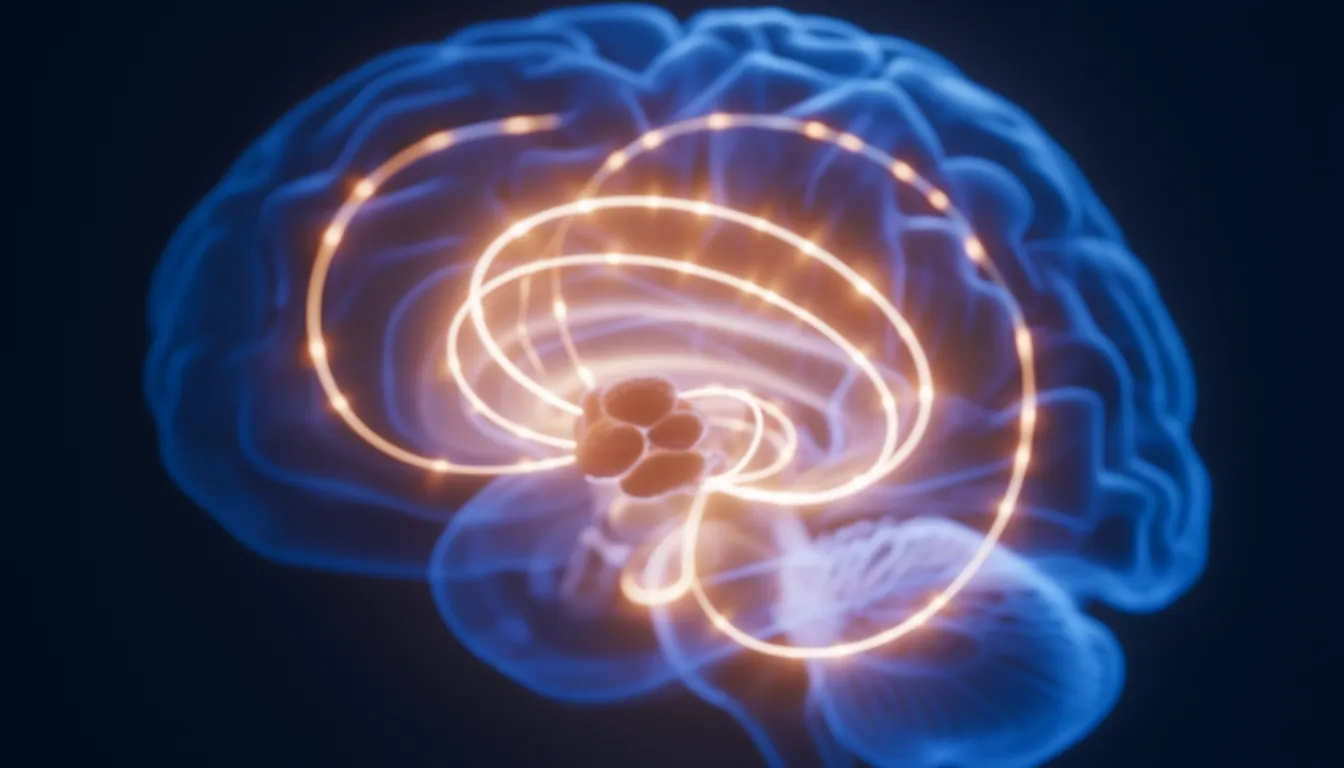
Basal ganglia
Also known as: basal nuclei, striatum
In one sentenceThe basal ganglia are deep brain nuclei that loop with the cortex and thalamus to start and select movements and to learn habits.
Components
The basal ganglia are not a single structure but a set of nuclei: the striatum (caudate and putamen), the globus pallidus, the subthalamic nucleus and the substantia nigra.
The cortex–basal ganglia–thalamus loop
Signals leave the cerebral cortex, pass through the basal ganglia to the thalamus, and return to the cortex. This loop-shaped, large-scale neural circuit is thought to help pick one action among competing options and suppress the rest.
Direct and indirect pathways
In 1989 Albin and colleagues proposed that the basal ganglia contain a direct pathway that promotes movement and an indirect pathway that suppresses it, and that movement disorders arise when the balance between them breaks down. Dopamine acts on the two pathways in opposite directions.
Testing the model with optogenetics
For years the model rested on indirect evidence. In 2010 Kravitz and colleagues used optogenetics to switch the two pathways on separately in mice. Activating the indirect pathway reduced movement and caused freezing, while activating the direct pathway increased movement. In a mouse model of Parkinson’s disease, activating the direct pathway reduced the movement problems.
Research today
The grants listed on the official Stanford profile of Professor Jin Hyung Lee include a study of basal ganglia circuit dynamics (NIH/NINDS R01, 2015). The basal ganglia are an active area for understanding brain disorders at the level of circuits.
Related entries
- Dopamine — Dopamine is a neurotransmitter for movement, motivation and reward learning. Often called the pleasure chemical, it mainly signals prediction errors.
- Neural circuit — A neural circuit is a group of neurons connected by synapses that work together to carry out a specific function such as sensory processing, movement or memory.
- Optogenetics — Optogenetics delivers light-sensitive proteins to chosen neurons so researchers can switch those cells on or off with light, with millisecond precision.
- Jin Hyung Lee (neuroscientist) — Jin Hyung Lee is a Stanford associate professor of neurology, neurosurgery and bioengineering, known for optogenetic fMRI (ofMRI) and brain circuit research.
References
- The functional anatomy of basal ganglia disorders. Albin RL, Young AB, Penney JB. Trends in Neurosciences 12, 366–375 (1989)
- Regulation of parkinsonian motor behaviours by optogenetic control of basal ganglia circuitry. Kravitz AV et al. Nature 466, 622–626 (2010)
- Jin Hyung Lee — Stanford Profiles. Grants list (NIH/NINDS R01, 2015)