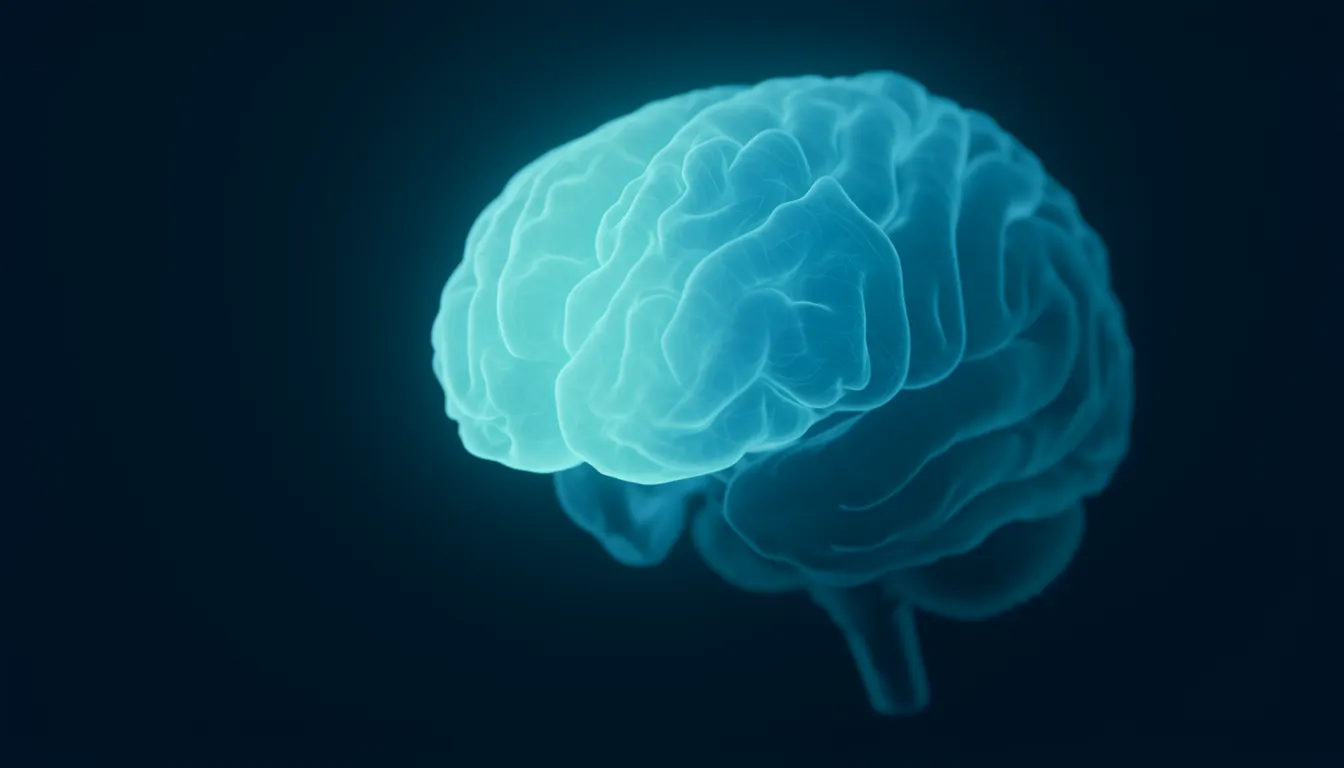
Frontal lobe
Also known as: frontal lobes, frontal cortex, frontal lobe function
In one sentenceThe frontal lobe is the front part of each cerebral hemisphere. It controls voluntary movement, produces speech and, through the prefrontal cortex, plans and regulates behavior.
Location
The frontal lobe is the front portion of each of the brain’s two cerebral hemispheres, lying behind the forehead. A groove called the central sulcus separates it from the parietal lobe behind it, and another groove, the lateral sulcus, separates it from the temporal lobe below.
What the frontal lobe does
The frontal lobe is not a single unit. Different parts of it carry out different functions.
- Voluntary movement. The strip of cortex just in front of the central sulcus is the primary motor cortex, the main region responsible for voluntary movement. In 1937 Wilder Penfield and Edwin Boldrey mapped it in people with electrical stimulation and found that the body is laid out along it as an orderly map.
- Speech production. In 1861 the French surgeon Paul Broca described two patients who had lost the ability to speak after injury to the rear part of the inferior frontal gyrus. The region is now called Broca’s area.
- Executive functions. The frontal lobe is where much of planning, reasoning, problem solving and emotional regulation takes place. Research on these functions centers on its front-most part, the prefrontal cortex. Earl Miller and Jonathan Cohen proposed in 2001 that the prefrontal cortex keeps goals active and sends bias signals that steer activity in other brain regions toward the task at hand. It is also central to research on working memory.
Broca’s patients revisited
In 2007 Nina Dronkers and colleagues scanned the preserved brains of Broca’s two patients with high-resolution MRI. In both, the damage reached well into medial regions of the brain, beyond the surface lesions Broca had described. The area Broca originally identified also did not match exactly what is now called Broca’s area.
One lobe, several kinds of control
Damage to the frontal lobe has long been linked to problems with executive control, but lesion studies suggest this is not one ability. Reviewing patients with frontal lesions in 2007, Donald Stuss and Michael Alexander argued that executive function is a set of separate but interrelated attentional control processes rather than a single central executive. They described three, each tied roughly to a different area: energization (upper medial frontal cortex), task setting (left lateral) and monitoring (right lateral).
A 2010 study by Maria Roca, John Duncan and colleagues added a caution. On some widely used executive tests, such as Wisconsin Card Sorting, the poorer scores of patients with frontal lesions were entirely explained by lower fluid intelligence, the capacity for novel problem solving. Other tasks, including some cognitive and social tests, showed deficits that fluid intelligence did not fully explain.
Loops with deeper structures
Much of the frontal lobe works in loops with structures beneath the cortex. In 1986 Garrett Alexander, Mahlon DeLong and Peter Strick described parallel, functionally separate circuits that run from the cortex through the basal ganglia and thalamus and back to the frontal lobe. Dopamine neurons in the midbrain also send signals to the prefrontal cortex.
Is the human frontal lobe unusually large?
Humans’ distinctive cognitive abilities are often credited to a frontal lobe that grew disproportionately during evolution. In 2002 Katerina Semendeferi and colleagues compared MRI scans of living primates, including all the great apes, and found that human frontal cortex was not disproportionately large relative to theirs. They suggested that differences in individual cortical areas and richer interconnections may matter more than overall size.
Related entries
- Prefrontal cortex — The prefrontal cortex, just behind the forehead, runs executive functions such as planning, impulse control and working memory, and matures last.
- Working memory — Working memory holds information in mind for seconds while you manipulate it, supporting mental arithmetic, conversation and planning.
- Basal ganglia — The basal ganglia are deep brain nuclei that loop with the cortex and thalamus to start and select movements and to learn habits.
References
- Lobes of the brain. Queensland Brain Institute, The University of Queensland
- Somatic motor and sensory representation in the cerebral cortex of man as studied by electrical stimulation. Penfield W, Boldrey E. Brain 60, 389–443 (1937)
- Paul Broca's historic cases: high resolution MR imaging of the brains of Leborgne and Lelong. Dronkers NF, Plaisant O, Iba-Zizen MT, Cabanis EA. Brain 130, 1432–1441 (2007)
- An integrative theory of prefrontal cortex function. Miller EK, Cohen JD. Annual Review of Neuroscience 24, 167–202 (2001)
- Is there a dysexecutive syndrome?. Stuss DT, Alexander MP. Philosophical Transactions of the Royal Society B 362, 901–915 (2007)
- Executive function and fluid intelligence after frontal lobe lesions. Roca M et al. Brain 133, 234–247 (2010)
- Parallel organization of functionally segregated circuits linking basal ganglia and cortex. Alexander GE, DeLong MR, Strick PL. Annual Review of Neuroscience 9, 357–381 (1986)
- Humans and great apes share a large frontal cortex. Semendeferi K, Lu A, Schenker N, Damasio H. Nature Neuroscience 5, 272–276 (2002)