The ‘Only One Way’ Trap
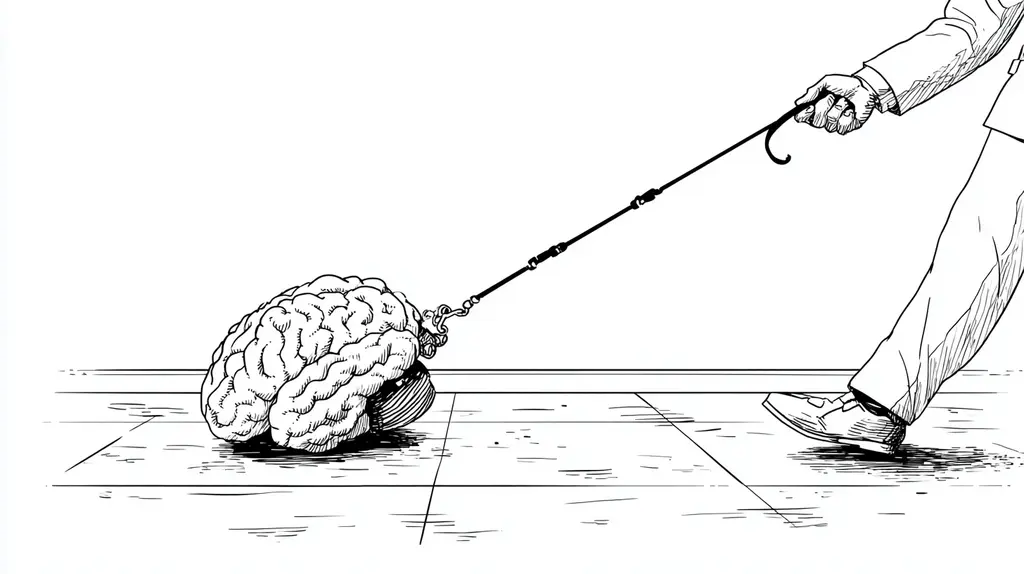
Hey everyone! Ever felt totally stumped trying to solve a problem, even when the solution was right in front of you? It’s like your brain just *refuses* to see things differently. That, my friends, is often functional fixedness at play! It’s a super common cognitive bias where we tend to see objects only in terms of their most common or usual function. So, if you need to hammer a nail but only have a shoe, your brain might get stuck thinking, “Shoes are for feet!” instead of “Hey, this shoe could totally work as a makeshift hammer!” It limits our perception, making us miss alternative uses for everyday items.
Think different.
How Our Brains Get ‘Stuck’
Our brains are amazing at creating shortcuts and routines to make life easier. This efficiency is usually a good thing – imagine having to consciously think about every step of tying your shoelaces every single day! But sometimes, this efficiency can backfire. When we learn a particular function for an object, our brains can form strong associations that are hard to break. It’s like your brain is super-optimized for one task, which makes it less flexible when you need to improvise. This mental ‘groove’ can make it tough to adapt and innovate, keeping us from seeing the world with fresh eyes.
Beyond Fixedness: Boosting Your Brain’s Flexibility
Are there ways to train my brain to think outside the box?
You bet there are! You can totally train your brain to be more flexible and less prone to functional fixedness. One awesome technique is ‘divergent thinking’ – try taking an everyday object, like a paperclip, and listing as many uses for it as you can imagine, no matter how wild! Also, when facing a problem, consciously try to break it down into smaller, abstract components instead of focusing on its initial presentation. Reframing the problem entirely can also help, like asking, “What if I didn’t have this tool, what else could I use?” Even changing your physical environment can sometimes shake loose new ideas!
Can functional fixedness really stop me from being creative?
Oh, absolutely! Functional fixedness is like wearing blinders when you’re trying to navigate a creative maze. If your mind is locked into the ‘normal’ uses of things, you’ll struggle to invent new solutions or ideas. Imagine being a designer trying to create a multi-functional piece of furniture; if you only see a chair as “for sitting,” you’ll never think to make it also a storage unit or a small table. It squashes our ability to brainstorm freely and explore unconventional paths, making us miss out on truly innovative breakthroughs. It’s all about breaking free from those mental habits!
What’s the famous ‘Candle Problem’ everyone talks about?
The Candle Problem is a super classic psychology experiment that perfectly illustrates functional fixedness! Here’s the setup: you’re given a candle, a box of thumbtacks, and some matches. Your challenge is to fix the candle to a wall so it can burn without dripping wax on the table below. Most people try to tack the candle directly to the wall or melt it, but those approaches don’t work. The trick? You need to empty the thumbtacks from their box, tack the *empty box* to the wall, and then place the candle inside it. The box’s usual function (holding tacks) makes it hard to see its potential as a platform for the candle. Mind blown, right?!
- LVIS Neuromatch – Explore advanced AI solutions for neuroscience.
- Neuvera – Discover more about cognitive assessment and brain health.